
The headlines following release of the Giving USA 2026 Annual Report on Philanthropy have been decidedly upbeat for a change. “U.S. Giving Hits $617 billion,” trumpeted the news, accompanied by celebrations of a 3% growth in total giving and a remarkable 17% surge in charitable bequests. Although still short of the 2021 total of $661 billion, the 2025 numbers landed as a breath of fresh air for planned giving officers who endured the tumultuous post-pandemic dips and rocky inflationary markets of recent years. And, some pundits are already boldly proclaiming that the long-anticipated “Great Wealth Transfer” has officially kicked off.
Here are top line numbers at a glance:
| Giving USA 2026 Snapshot: Key 2025 Giving Benchmarks | |||
| $617 billion | +3.0% | +17.0% | 64% |
| Total Charitable Giving | Inflation-Adjusted Overall Growth | Surge in Charitable Bequests | Individual Giving Share of Total |
But before we stretch banners across the street and launch a parade celebrating that our fundraising goals will effortlessly take care of themselves, it is worth pausing to look past the top-line celebratory hoopla. As we’ve noted in years past: the real value of the Giving USA Report lies not in its function as an annual scoreboard, but rather in its capacity to illuminate long-term trends, expose underlying structural shifts, and point toward data-informed insights for smart fundraising.
The Elusive Search for Precision
The fact remains, it is remarkably difficult to answer the seemingly simple question, “How much do Americans give to charity each year?” There is no single centralized source in the United States for measuring charitable giving with absolute precision. Donors make contributions in a dizzying array of ways and forms. While some gifts are documented via itemized deductions on tax returns, many – probably most – are not, meaning U.S. Treasury data provides only a partial perspective.
Furthermore, evaluating complex vehicles like donor-advised funds (DAFs) is structurally complicated because two distinct transactions occur: the initial contribution from the donor to the sponsoring organization, and the ultimate distribution to the charitable beneficiary. To its credit, the Giving USA methodology strives to avoid double-counting by reporting DAF contributions under individual giving in the year they occur, rather than tracking subsequent distributions as new gifts in the year the distribution is finally made.
The point is: the Giving USA Report is a sophisticated estimate – a rolling survey – and not a flawless ledger. Because new data continually surfaces, Giving USA routinely adjusts past reported numbers, sometimes years after the fact. For instance, bequest numbers are notoriously prone to multi-year recalculations as estate tax filing data slowly settles. Still, Giving USA is the longest-running and most consistently collected set of data available. And, instead of obsessing over precise single-year tallies, our focus remains on the macro trends and shifting behaviors over time.
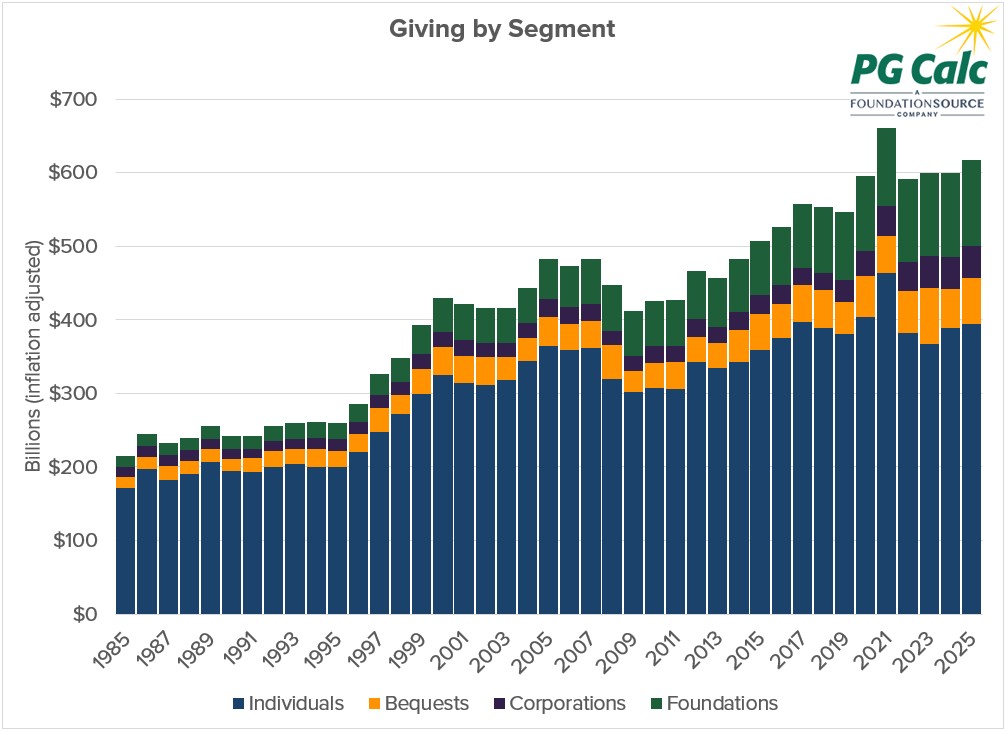
This graph shows inflation-adjusted total giving for the past 40 years by segment: individuals, bequests, corporations, and foundations.
Graph Data Source: Giving USA 2026 Annual Report on Philanthropy
As we’ve noted in previous years, it seems there’s little correlation between changes in tax law or the balance of political power and charitable giving, however the strength of the economy seems to have a significant impact. For example, giving dropped significantly following the “Great Recession” of 2008-09 and did not recover to pre-recession levels until several years later. On the other hand, there was a crisis-driven spike in giving in 2021 – in the midst of the global pandemic – led primarily by a surge in individual giving.
In addition, it’s worth noting that individual giving, which accounted for 80% of the total four decades ago, has steadily declined to about 64% of total giving in 2025. During that same period giving by foundations increased from about 7% of the total to 19%. And, remember, DAF giving is reported as individual giving when the contribution is made to the DAF and not when the distribution is made from the DAF, so the explosion of DAFs does not account for the growth of foundation giving.
Bequests and the Great Wealth Transfer
For those of us involved in planned giving, the standout story of the Giving USA Report is undoubtedly the growing momentum of charitable bequests, which jumped by nearly 17% in 2025. Strikingly, this marks the third year out of the last four that bequest giving has clocked double-digit annual increases. For years, demographic futurists have predicted an unprecedented generational wealth transfer – estimated at upwards of $18 trillion – as aging Baby Boomers pass their assets to heirs and charitable causes. This sustained multi-year spike may suggest that the opening wave of this historic transfer is upon us.
While researchers at the Indiana University Lilly Family School of Philanthropy rightly caution that we need a few more years of definitive IRS estate tax data before declaring the transfer is off to the races, the frontline reality for planned giving officers is clear: the window of opportunity is wide open. Nonprofits that have systematically invested in their planned giving programs are reaping the rewards, often receiving multi-million-dollar estate distributions from quiet, loyal donors who had contributed modest, small-dollar annual gifts for decades.
The Growing Reliance on Mega-Gifts
While the top-line numbers are expanding, a closer look reveals an ongoing structural risk that should give every charity leader pause. American philanthropy is becoming increasingly top-heavy, relying on a shrinking pool of exceptionally wealthy donors. As noted above, over the past four decades, the share of total giving contributed by living individuals has steadily declined, dropping from 80% in 1985 to just 64% today. It may be that, concurrently, giving has become more tightly tied to macro-economic indicators and, particularly, stock market volatility.
In 2025, “mega-gifts” – defined as individual contributions exceeding 0.1% of total annual giving ($600 million or more in 2025) – reached a staggering $19.2 billion. This means a microscopic group of ultra-high-net-worth individuals accounted for roughly 4% of all individual giving nationwide. For perspective, consider the concentration of these dollars:
- MacKenzie Scott: Contributed $6.65 billion, representing more than a third of all mega-giving in 2025
- Michael Bloomberg: Donated $4.3 billion to various primary causes
- Bill Gates: Distributed $3.7 billion through philanthropic channels
- Paul Allen Estate: Realized a massive $3.1 billion charitable bequest, heavily driving the year’s bequest surge
While these extraordinary acts of generosity propel the sector forward, they introduce systemic volatility. When a sector becomes excessively reliant on a handful of billionaires and a booming S&P 500, the inherent unpredictability of the financial markets begins to bleed directly into the financial stability of our charitable institutions.
Sub-Sector Winners and Losers
Reflecting a year characterized by robust financial markets alongside prominent federal spending cutbacks and policy shifts, donors responded with varied levels of urgency across different sub-sectors. Educational institutions and advocacy-heavy organizations experienced the strongest tailwinds, while traditional sectors, such as religion, experienced flat or negative inflation-adjusted returns.
| Charitable Sub-Sector / Cause | 2025 Growth Rate (Inflation-Adjusted) | Primary Growth Drivers & Dynamics |
| Education | +8.9% | Driven by massive major gifts and robust stock market asset appreciation. |
| Public-Society Benefit | +8.7% | Propelled by substantial year-end influxes into commercial and community DAFs. |
| Environment & Animals | +8.2% | Spurred by donors actively “fighting back” against shifting federal environmental rollbacks. |
| Arts, Culture & Humanities | +4.7% | Steady recovery backed by broader consumer confidence and discretionary wealth. |
| Health | +3.3% | Moderate gains, heavily supported by regional healthcare major gift campaigns. |
| Human Services | +2.6% | Grew modestly; facing intensified localized demand despite increased funding. |
| International Affairs | +1.4% | Supported by private individual responses to federal cuts in traditional USAID programs. |
| Religion | -0.2% | Marginally lower, continuing a long-term secular trend relative to other sectors. |
Giving as a Percent of Income
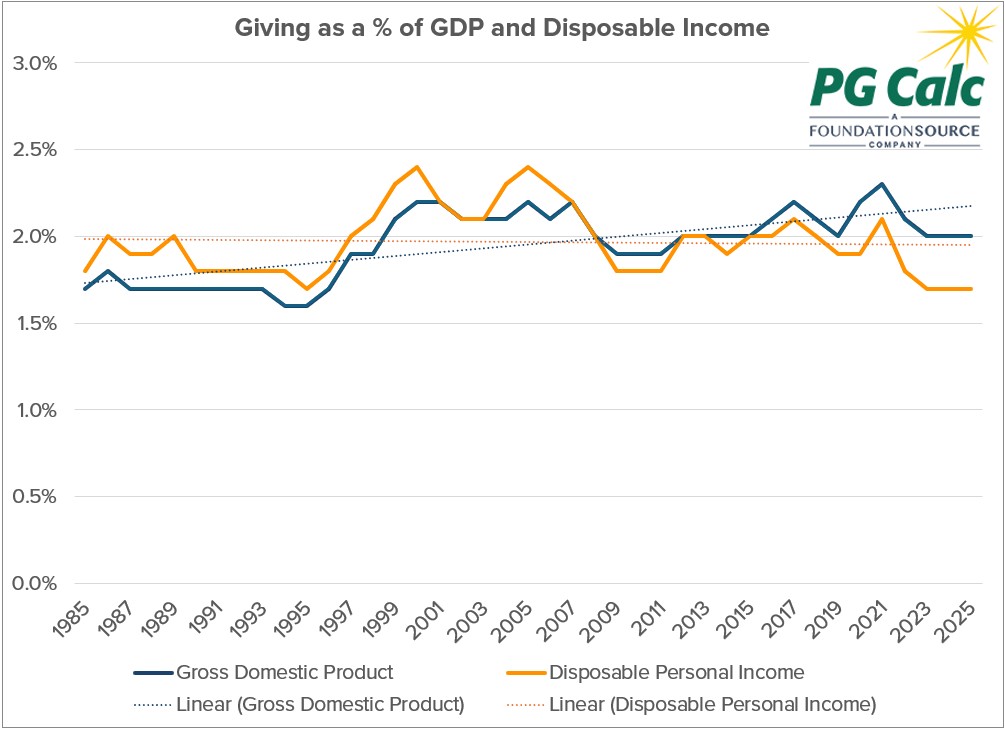
Finally, there’s another aspect of charitable giving worth considering. Measuring total charitable giving as a percent of Gross Domestic Product (GDP) provides an indication of giving as a share of the total economy, and individual giving as a percent of Disposable Personal Income shows how much individuals give compared to the theoretical maximum they could give. The Giving USA data over the past four decades show a remarkably consistent pattern, as exhibited in this graph.
Graph Data Source: Giving USA 2026 Annual Report on Philanthropy
Overall, the two indicators track one another closely – which is not surprising given that individual giving remains the largest component of total giving. And, even with some ups and downs, the median for both is 2%, with little variability. However, the trend lines indicate that, while total giving as a percent of GDP has been increasing gradually over the last 40 years, individual giving as a percentage of Disposable Personal Income has remained flat, even decreasing slightly.
Considering that there has been enormous organizational investment in fundraising during these 40 years, leadership may question whether these expenditures have paid off. The data suggest that despite the professionalization of fundraising, advances in data mining and metrics, and all of the rest, we have yet to increase at all how much Americans give to charity relative to what they could give.
Strategic Implications for Charitable Gift Planners
What do these insights mean for your day-to-day work as a planned giving officer? The data provides several clear, actionable directives for designing a resilient, future-proof fundraising strategy:
- Double Down on Planned Giving Immediately: If your organization has been hesitating to invest resources into an estate and legacy giving program, the Giving USA Report is your clear wake-up call. The wealth transfer is actively happening! Your donors are aging. You need to be actively engaging them in estate conversations. You can be sure other organizations are.
- Focus on Qualified Charitable Distributions (QCDs): With over 70 million Baby Boomers navigating retirement, QCDs from Individual Retirement Accounts (IRAs) represent a massive, friction-free pipeline for new gifts. Donors who routinely give small annual gifts can easily be educated on the tax advantages of directing lifetime or testamentary distributions directly from their retirement accounts.
- Cultivate Deeper, High-Touch Relationships: Because fundraising remains fundamentally a relationship business, superficial transactional outreach is no longer enough. The flatlining of individual giving at roughly 2% of disposable income over several decades – despite massive sector-wide investments in data mining, marketing, and fundraising – underlines a sobering truth: technology alone cannot replace genuine, values-driven human connection.
- Remember: It’s About Mission: Though there was much else going on at the time, that spike in individual giving in 2021 – to levels we’ve not seen since – is a reminder that, when the chips are down, and when we’re faced with uncertainty, Americans respond with generosity and caring for one another. Job one is giving your donors a compelling reason to give. The rest is helping them with the details of financing their generosity.
Conclusion: An Enduring Truth
Ultimately, reducing the comprehensive Giving USA Report to a single breathless headline oversimplifies the profound, beautiful complexities of American philanthropy. Amidst changing tax codes, shifting political power dynamics, and the cyclical booms and busts of Wall Street, one enduring truth remains constant: donors consistently find compelling reasons to make generous contributions to causes that matter deeply to them.
Our privilege and responsibility as charitable gift planners is to move past the noise of the headlines, step into the game, and provide our donors with the strategic, empathetic guidance necessary to execute the smartest, most meaningful gifts possible.